This dialog is opened with  Open protected file(s) toolbar button or using Open database with password button on each side of the Home tab. Also, if we are opening any previously loaded DB using the Recent databases panel on the Home tab, and that DB was loaded previously without Save passwords - this dialog will be opened to enter the password again.
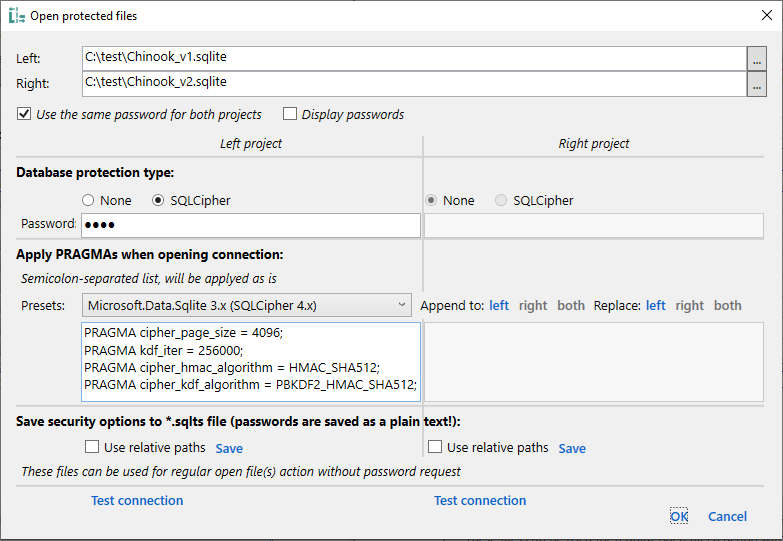
Use the same password and PRAGMAs for both databases - use this option to compare database having the same protection options. In this case only Right file path field will be active for the right side, all other options will be used from the left side.
Display passwords shows all password texts.
Save passwords (to reopen from recent DB list without password request) as mentioned simplifies work with recent databases, however please note that encrypted passwords are saved on your computer in the application settings file.
Encryption selects how the file is protected. Encrypted files are opened using SQLite3 Multiple Ciphers library, which supports the following encryption types:
If a file was encrypted with non-default options of the selected encryption type, these options can be set by PRAGMAs listed in Apply PRAGMAs when opening connection section. Encryption options are applied before the password, all other PRAGMAs are applied after it. PRAGMA cipher is not needed, it is set by the Encryption field. PRAGMA cipher with other encryption type is not allowed, and it is not allowed at all for None. The password can be set only by the Password field, PRAGMAs key, hexkey, rekey and hexrekey are not allowed.
Test buttons are available to test encryption settings without closing dialog. The result is shown under the buttons: 'Good' for successful connection or error text for failure. Long error text is cut, the full text is shown in the tooltip and can be copied by the Copy button.
If you often connect to the same databases, you can save these connection options to *.sqlts files as suggested on this dialog using Save button for each side. Please note that if Encrypt passwords is not selected then passwords are saved as a plain text, so you should save these files to the safe location. These *.sqlts files can be opened directly from the main application window using  Open database(s) toolbar button or using command line arguments.
For SQLCipher encryption type, PRAGMAs that set encryption options can be written in two ways: using SQLCipher names or using SQLite3 Multiple Ciphers names. The application converts SQLCipher names to SQLite3 Multiple Ciphers names and applies these PRAGMAs before the password. All other PRAGMAs are applied as is, after the password.
Both ways give the same result. For example, a file created by SQLCipher 3 can be opened with one line:
PRAGMA legacy = 3;
or with the same settings listed one by one (the "Microsoft.Data.Sqlite 2.x (SQLCipher 3.x)" preset):
PRAGMA cipher_page_size = 1024; PRAGMA kdf_iter = 64000; PRAGMA cipher_hmac_algorithm = HMAC_SHA1; PRAGMA cipher_kdf_algorithm = PBKDF2_HMAC_SHA1;
| SQLCipher PRAGMA | SQLite3 Multiple Ciphers PRAGMA | Meaning |
|---|---|---|
| cipher_compatibility = 1..4 | legacy = 1..4 | Use default settings of the SQLCipher major version. Without this PRAGMA, SQLCipher 4 settings are used. |
| cipher_page_size = 1024 | legacy_page_size = 1024 | Page size |
| kdf_iter = 64000 | kdf_iter = 64000 | Number of key derivation iterations |
| cipher_kdf_algorithm = PBKDF2_HMAC_SHA1 | PBKDF2_HMAC_SHA256 | PBKDF2_HMAC_SHA512 | kdf_algorithm = 0 | 1 | 2 | Key derivation hash algorithm |
| cipher_hmac_algorithm = HMAC_SHA1 | HMAC_SHA256 | HMAC_SHA512 | hmac_algorithm = 0 | 1 | 2 | HMAC hash algorithm |
| cipher_use_hmac = ON | OFF | hmac_use = 1 | 0 | Use HMAC |
| cipher_plaintext_header_size = 32 | plaintext_header_size = 32 | Size of not encrypted database header |


